
Habitats
Hunt Hill is unique in that it protects many habitat types found in Wisconsin! Walk the edges between the meadow and woods, or go to Heron Point on Lower Twin Lake for spectacular sunsets and glimpses of some of our more reclusive inhabitants – indigo buntings, golden-winged warblers, sandhill cranes, green herons and more. Frequent and favorable sightings occur at dawn and dusk.
HABITATS

Bogs: Hunt Hill has two sphagnum bogs. One bog is located directly on site and features a ‘bog walk’ that visitors can use to walk out into the bog for closer examination of the unique plants. Some of these unique plants include: rose pagonia, grass pink, arethusa, and pink lady’s slipper orchids, the pitcher and sundew insectivorous plants, wild cranberries, tamaracks, and, of course, sphagnum moss!
The second bog, Dory’s Bog, can be found two miles from our main camp. Dory Kummer Vallier, from the Milwaukee area, came to the Audubon Camp of Wisconsin (now Hunt Hill) many years ago – probably in the 1960’s. The story goes that while at Hunt Hill she met, fell in love with, and later married Jacque Vallier who at that time was the director of the camp.
In 1963, Dory gifted the 35 acre bog to the National Audubon Society as part of the Hunt Hill property. In 1974 it was dedicated by the Wisconsin Scientific Areas Preservation Council as State Natural Area #116. The original acreage did not provide complete protection of the entire bog, but since then, approximately 40 additional acres surrounding the entire bog have been acquired. Dory’s Bog has been the subject of several research projects, as well as various group visits.

Glacial Lakes: Hunt Hill’s property surrounds two glacial lakes, Upper and Lower Twin Lakes. These lakes were originally created when a large chunk of glacier broke off and sediment was deposited around it. This formed our lakes and created a large ridge (where camp now stands). Today, we find that Upper Twin Lake has spots as deep as 44 feet and Lower Twin Lake with spots as deep as 37 feet. Two very narrow and shallow channels give us canoe access to Big Devil’s Lake and Lower Twin Lake.
The newest footbridge, the Nordskog Bridge, is located along the edge of Big Devil’s Lake and our channel. It offers beautiful views and can be accessed by hiking the Bear Trail. Our second footbridge, the Old WCC Bridge, is found along the Bear Trail on the opposite end of the Twin Lakes chain.We have a waterfront area that serves many purposes. In addition to our swimming area, it is also our canoe launch site, ponding and lake laboratory area.
Cabin renters are allowed access to canoes and, if a group is interested in swimming, we can arrange for a lifeguard to be onsite. *Swimming is only available with a Hunt Hill lifeguard present and must be arranged ahead of time.
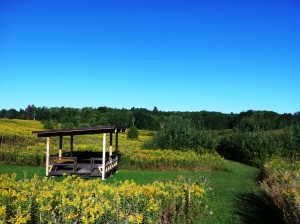
Meadow: While Hunt Hill is located too far north to appropriately be called a ‘prairie,’ the 40 acre hay meadow of the original farmstead is being allowed and encouraged to revert to native flora and fauna. Prairie burns are conducted periodically, as weather allows, to encourage the native perennial plants while discouraging succession to a forest habitat.
Several miles of mowed grass trails follow the outside perimeter and cut through the center of the meadow, allowing excellent access for hikers of all ability levels. Birds, butterflies, dragonflies, wildflowers and lots of other wildlife can be observed up close.
We also host a bluebird trail which has over 25 nest boxes and is managed with the help of BRAW, Hunt Hill staff, and volunteers. Since implementing the bluebird houses, we’ve seen fledgling numbers maintain a healthy level. The birch tree posts installed along the mown paths are essential hunting and perching posts for bluebirds.

Forest: Forest comprises approximately 55% of our acreage and includes dry-mesic forest and upland hardwoods. Much of the adjoining uplands are also second-growth hardwoods.
Watch along the hiking trails for old charcoal remnants of trees caught by forest fires – the most recent was in the early 1930’s. Old pine stumps often bear the black scars. Along the Red Oak West Trail a large old white pine shows charcoal inside the tree in a hollow.
Across the hills one will find dozens of large old white pines – too small to be harvested back in the 1800’s – now so big that two grown adults can’t touch their fingertips around the base of the trees. They tower far above surrounding deciduous old-timers, and are readily visible from surrounding lakes. Some are nest sites for bald eagles and owls. At the switchback on the Red Oak West Trail, you will find the best examples in a grove forgotten – right next to the glacial kettle.
Hunt Hill is the location of one of the oldest forestry studies still being conducted in the state of Wisconsin. The thirty original forest study plats were set out in 1933 by University of Minnesota graduate student, Willis Eggler, through the assistance of Aldo Leopold.
Randomly scattered throughout the forest, yellow-topped steel fence posts, as re-established by former Hunt Hill staff member Dr. Lucy Tyrrell, mark the location. The study will take hundreds of years to complete as researchers watch, survey, and analyze the probable transformation into a climax basswood/sugar maple forest.
Due to the uniqueness and some of the rare plants that can be found on the property, much of the west portion of the property is also designated State Natural Area #116.